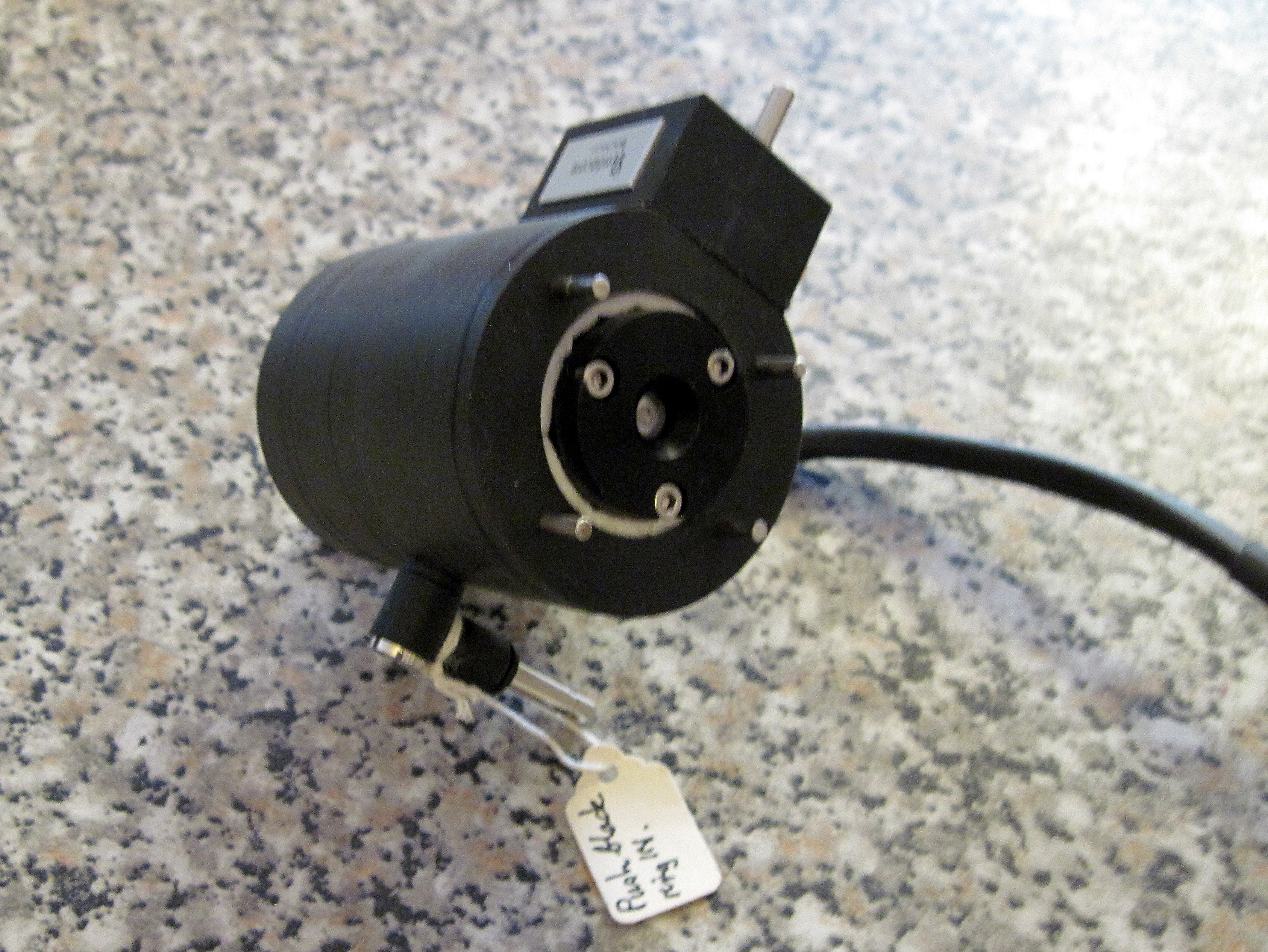
In some cases, it is essential to control the environment to which the sample is exposed. Thus, catalysts may require heating and evacuation or be exposed to a vapour. The Model H-4 cell encloses the sample behind a thin borosilicate glass or silica window. The cavity containing the sample can be evacuated or filled with gas through the standard ¹/16" stainless steel micro tubing familiar to all chromatography users and, of course, the cell body can be heated. In this case, we are restricted to 180°C for FT experiments. To control the heating process and to monitor the temperature of all the Ventacon Hot Cells, we recommend that users purchase the Series D Universal Power Supply or the new DV hot cell supply. These units provide a stabilized DC supply at ~24V. Temperature sensing and control is achieved using a CAL differential proportional controller. HIGHER TEMPERATURES It is feasible to fit a filter into the optical path of FT Raman spectrometers to restrict the effect of the black body emission. The filter blocks radiation at shifts greater than 2000cm-1 enabling users to record spectra at temperatures up to 300°C or even a little higher. Remember – the filter attenuates the black body radiation and the Raman bands as well so bands at higher shifts do not appear. Where laser sources in the deep red are to be employed, much higher temperatures can be used, e.g. we have recorded spectra above 400°C on a Perkin Elmer Raman Station. Laser at 760nm. The basic heated cell as explained above is designated H-15 followed by the maximum temperature to which they will operate, i.e. H-15-200. The higher temperature versions become H-15-300 and H-15-500. It is not possible to produce a sealed cell operating above 200°C.
Special Note: There is a serious risk that your spectrometer will be over-heated if the high temperature versions of the Ventacon heated cells are used. You MUST CONTACT Ventacon BEFORE ORDERING so that we can advise. |
-.jpg)